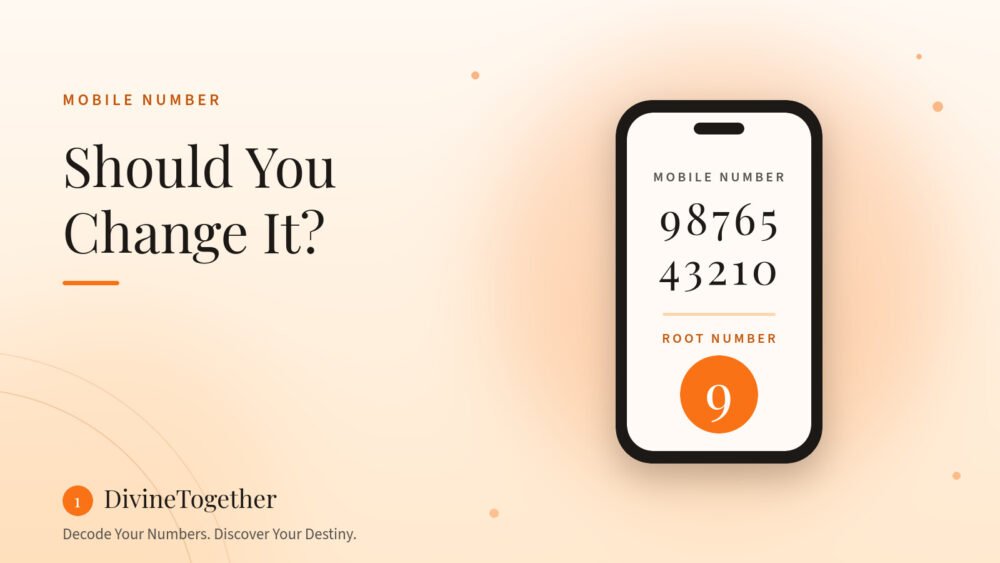
This is the single most common question we get asked, usually right after someone has had a rough few months and starts wondering if their phone number is part of the problem.
When a Number Change Is Actually Worth Considering
- You changed your number recently and problems started shortly after, in a pattern too consistent to ignore.
- Your current number reduces to a digit that clashes with your core Life Path or Destiny Number rather than supporting it.
- You are about to start something significant (a new business, a new role) and want the number aligned before, not after.
When It Is Probably Not the Number
If the same difficulty shows up regardless of what number you have used over the years, across multiple numbers, that is not a number problem. Numerology explains tendencies and leanings; it does not override a pattern that keeps repeating no matter what changes around it.
How the Root Vibration Is Calculated
Add every digit in the number together and reduce to a single digit, the same way a Life Path is calculated. A mobile number ending in a string of high, fast-moving digits often reduces to a number tied to change and movement; one dominated by steadier digits often reduces to something calmer. The digit alone is not the analysis; how it sits against your own chart is.
What an Actual Analysis Looks At
We calculate your numbers root vibration, then check it against your core chart: not in isolation, since a number can look unlucky as a keyword list and still fit you fine once compared to your own numbers.
The Practical Reality of Changing a Number
A number change has a real cost: updating contacts, business cards, two-factor authentication, bank accounts. We will tell you plainly if the analysis does not support the disruption. Half of the people who ask us this question keep their existing number after the analysis.